
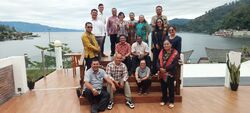

"Sustainable Management of Diaconia for Holistic Mission": That was the title of a training held last June in Parapat, Indonesia, by the United Evangelical Mission (UEM). Fourteen participants from almost all UEM member churches in Asia attended the training, uniting knowledge and competence from Sri Lanka in the west to Papua in the east. The facilitator of this training was an alumnus of the UEM Scholarship program, Rev. Yusuf Tarigan from GBKP*. He is executive director of the Ate Keleng Foundation, a GBKP social organization in Sumatra, which is active in case of natural disasters, as well as in micro credit support for local communities.
Understanding Interconnections
Ridho Simamora, program coordinator in the Asia Regional Office, speaks about the starting point of the training: “Diaconia, as the church’s ministry of service to the world, is essential in promoting holistic mission to address physical, emotional, spiritual needs and even environmental issues.” With growing global challenges, such as poverty, climate change, and socio-economic inequality, Simamora says it is crucial for church workers to understand the interconnections between social outreach, sustainability, and mission.
Participants reflected on these links both theologically and practically. During this training, they learned more about bringing together three things: Spiritual Care, Community Development and Environmental Responsibility. “This way, the church workers can effectively manage their sustainable diaconal work when they engage in mission”, Simamora says. They visited KSPPM, an organization of North Sumatra women who engage against environmental destruction, as an example of holistic Diaconia: In 2022, KSPPM and its Batak allies achieved a major success when the government granted a total of 7,000 hectars of forest as traditional lands back to six Batak communities.
Based on God's Wisdom
For Simamora this is diaconal work, and a good example for churches to follow: “Diaconia is a strategic ministry that should be reinforced in churches to address their holistic challenges. It should be based on the wisdom of God and the direction of the Holy Spirit, not on human knowledge and might. For churches, diaconia is a sacred spiritual calling, not a project. A project has time limitations, while diaconal work doesn’t. Thus, at the grassroots level, it is essential to strengthen human resources, church leaders and elders, so that the impact of our diaconal work is effective.”
*GBKP = Gereja Batak Karo Protestan (Protestant Church of the Karo Batak)


 spenden@vemission.org
 0202-89004-195