


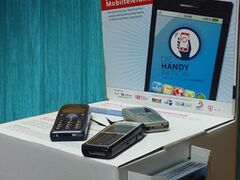
“2017 we started calling for people to collect old mobile phones. We want to raise awareness of the social and environmental impacts of global mobile phone production and the sometimes inhumane working conditions involved in mining valuable raw materials,” says Rev. Matthias Schmid, coworker in the Regional Service of the United Evangelical Mission (UEM). Part of his “Bergisches Land” region is the Wuppertal all-day high school “Johannes Rau”. This UNESCO project school is involved in the “mobile phone campaign” in the local province of NRW (Germany), in which the UEM is one of the sponsoring organisations. Mobile phones contain rare and important raw materials that are professionally recycled by the campaign. This reduces the demand for new resources, and the financial outcomes support human rights projects, for example in South Africa and the DR Congo.
From the mobile phone campaign to profile classes
During a visit by Matthias Schmid in July 2025, Dr Oskar Brilling, a teacher at the high school, handed over the collected old mobile phones. Here at the school, the campaign is part of a sustainable commitment that began in the school’s “Future Kids” working group.
“The enthusiasm for taking part in the mobile phone campaign was an important impulse for our school to establish so-called profile classes with a focus on music as well as nature and the environment,” says Dr Brilling. In these classes, students dedicate an additional weekly lesson to exploring their chosen topic in depth – supported by the “Chance to Start” programme of the local province.
Turning waste into something new
A current example of the commitment of the environmental profile class is a project by the 5th graders on the topic of avoiding plastic. Barin, Hiba, Lamiar, Joschua and Varuzhan from class 5b are working together. They develop creative ideas to promote recycling and the conservation of resources in their school. Together, they have already designed posters and collection boxes and gone from class to class, collecting old pencils, ballpoint pens, folders and empty rolls of adhesive tape.
“We don’t just want to throw the waste away. Something new is made from the waste we collect,” explains Lamiar. Her fellow student Hiba adds: “Plastic remains in the ground for millions of years. We saw pictures of polluted seas in our biology class.” And Barin emphasises: “There are so many old pens in schools – that’s why we collect them!”
The project is supported by the teachers Dr Oskar Brilling and Flora Begrich. Haris Sinnathurai, a Year 10 pupil and the school’s UNESCO student representative, is also impressed by the concept: “I am inspired by the commitment and the trust the school places in the pupils.”
For Matthias Schmid, this commitment is a strong sign: “I am very happy to see how the mobile phone campaign has been embraced by the school and developed into a building block of a sustainable school concept. The students are given real opportunities to engage in climate protection and create awareness both inside and outside the school.”



 spenden@vemission.org
 0202-89004-195