


Agriculture and Climate Justice in Rwanda
Climate change is already having serious effects in many regions – especially in rural areas. Droughts, crop failures, and dwindling resources are threatening the livelihoods of many people. But the churches on the ground are taking action: In Rwanda, the member churches of the United Evangelical Mission show how faith-based initiatives can combine ecological responsibility with social justice. Through targeted support from the UEM Communion, projects are being created that serve as drivers of change and sources of hope for many communities.
Climate-Resilient Agriculture: A Flagship Project of the Anglican Church
One example is the project "Climate Smart Agriculture to Mitigate the Impacts of Climate Change and to Increase Farmers' Productivity in Rwanda” It is implemented by the Rural Development Inter-Diocesan Service (RDIS) and four dioceses of the Anglican Church in Rwanda (EAR), a member church of the UEM, and co-financed by the UEM Communion of Churches. The project combines agricultural innovation with Christian compassion.
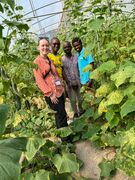
At the pilot farm in the Kamonyi District, at the Mbayaya Training Center, the project demonstrates how sustainable agriculture can work in practice:
-
Solar-powered irrigation systems bring filtered water to the plants
-
Crop diversification and rotation (e.g. cucumbers, peppers, tomatoes, beans, cassava) ensure sustainable food security
-
Organic fertilization through livestock improves soil quality
-
A cassava flour mill and soon a feed mixing machine increase local value creation
-
Training sessions for small-scale farmers strengthen knowledge and community
The results speak for themselves: Up to three cucumber harvests per year are possible – a real plus for food security and income. The sale of green peppers brings in up to 330,000 RWF per cycle – approximately 250 euros. The long-term goal: to develop a self-sustaining model farm for the region.
In addition, RDIS has distributed solar home systems and improved cookstoves to rural families. This project was also supported by the UEM Communion. The impact of this support is shown in the example of Claudine Nyiranizeyimana: “Our firewood costs have been reduced by half, and our children can study better in the evenings.” On the one hand, it is often the children who are responsible for collecting firewood in the families. On the other hand, the newly developed cookstoves produce less smoke and thus improve the indoor climate in the houses.
These simple but far-reaching changes not only reduce CO₂ emissions, but also raise the overall living standards in the communities.
The full report by Sarah Neputh, Assistant in the Africa Divivsion, who visited several projects and programs of the member churches in Rwanda together with Reuben Inganji, Project Officer for the Africa Region of UEM, can be found here
Further information about how the UEM Communion of Churches supports projects and programs can be found here: www.vemission.org/en/howwework


 spenden@vemission.org
 0202-89004-195