


“Interfaith dialogue is not only about tolerance — it’s about standing together for transformation.” says Thea Hummel, Head of Advocacy of the United Evangelical Mission (UEM), who was a trainer at the Leadership Training.
Here, 13 Church leaders from Asia, Africa and Germany gather in Zanzibar, Tanzania, for six days. This September, they come together to get in touch with one another and with UEM. At the center of their workshops and conversations are questions of church leadership in the year 2025: How do the climate crisis and religious extremism challenge the churches – and how can interfaith dialogue be an answer to both?
For UEM as a communion of churches, it is essential to work for a more just and peaceful world together with all its member churches, the integrity of creation and a reflected and interreligiously respectful sharing of the Gospel. The agenda combined academic input, exposure visits, interfaith encounters, and reflection sessions.
Seaming and soccer for dialogue
Pastor Lusungu Mbilinyi and Imam Prof Issa Ziddy present two interfaith initiatives of the ELCT/ECD* that are operating in the same house in Stone Town, the historic center of Zanzibar: Upendo and Zanzic. The participants also visited Islamic leaders of the island, as well as the Historical Sites and memorials of the East African slave trade.
In the project Upendo (Kiswahili for “love”) Muslim and Christian women learn seaming professionally. About 1000 women have already decided to pursue their education at this project, which sells the produced garments locally at the souk, the traditional market of Stone Town. Upendo has hosted many UEM volunteers.
The Zanzibar Interfaith Centre (Zanzic), established in 2009, promotes interfaith understanding and conflict resolution. One of their most successful strategies to address dialogue through sporting competitions have been mixed-faith soccer teams.
For Thea Hummel, these projects belong at the heart of churches’ engagement for peace: “Working side by side for justice, climate responsibility, and the empowerment of those on the margins reminds the world that spirituality and social responsibility belong together. Real peace begins when we choose to listen — and when faith inspires action.”
Addressing leadership responsibility
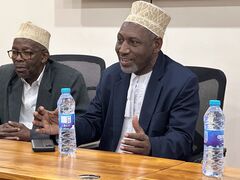
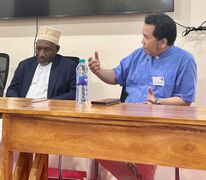
A highlight of the program was the meeting between church leaders and the Deputy Mufti of Zanzibar, Sheikh Mahmoud Mussa Wadi, and other religious leaders in the office of Mufti Mkuu. Sheikh Mahmoud presented the responsibilities of Muslim dignitaries in Zanzibar. He discussed with the church leaders how Christians and Muslims can effectively work together, both in Tanzania and in other countries.
“Church leaders, with their influence and guidance, can play a significant role in transformation processes”, says Rev Dr Félicité Ngnintedem. She is UEM Executive Secretary Division Global Programs, member of the Management Team and organized the training with her colleagues. She emphasizes how knowing other religions and especially their social change potential can help church leaders to work for a more just and peaceful world – not alone, but together with siblings of other faith.
Thea Hummel says, peace often begins in simple encounters, when people of different faiths sit together, listen without judgment, and talk about the ordinary struggles of our societies: “In those moments of honest conversation, trust grows and stereotypes fade. Interfaith dialogue is not an abstract exercise; it is the daily practice of seeing each other’s humanity and building community across difference.”
For more information on the engagement of church leaders in the UEM General Assembly, please visit our website.
About interfaith dialogue, you read more in this article.
*ELCT/ECD = Evangelical Lutheran Church of Tanzania, Eastern and Coastal Diocese


 spenden@vemission.org
 0202-89004-195