
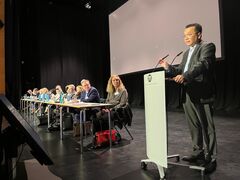

With a communion service at Christuskirche Zieverich in Bergheim on February 28, 2026, the constituting synod for the founding of the new Church District (Kirchenkreis Köln Linksrheinisch) began. The meeting then continued at the nearby conference center Medio.Rhein.Erft.
The new district is the result of a two-year process: 29 congregations from the Cologne metropolitan area, the Rhein-Erft district, and the Voreifel region have joined together. Declining membership numbers and structural changes made the merger necessary.
“The new church district brings together urban and rural congregations with very different mentalities that still need to grow together,” explained Dr. Heike Henneken, member of the authorized committee overseeing the process.
With more than 160 synod delegates, the new district synod is now the largest within the Evangelical Church in the Rhineland. Senior Church Councillor Dr. Wibke Janssen, Head of the Department of Theology and Ecumenism and member of the UEM Council, accompanied the merger process.
A Spiritual Process Rather Than a Mere Structural Reform
The creation of the new church district represents more than an organizational restructuring. In his greeting, Rev. Dr. Andar Parlindungan, UEM General Secretary, emphasized the spiritual dimension of the merger.
Three church districts are growing into a new whole—and this, he said, is not a sign of failure but can be an expression of spiritual maturation. The church is never static but always a “church in the making.” Its strength lies not in its size, but in its connectedness.
The UEM is represented in the new district synod through its Regional Service Cologne/Bonn. Parlindungan expressed his sincere thanks to the participating church districts for their support of international partnership work and the global fellowship of VEM member churches.
International Fellowship as the Church’s Core Identity
A central theme of his greeting was the international orientation of the church. The future of the church does not lie in regionalism but in global fellowship. International partnership is not an additional program but an expression of what the church fundamentally is: the one body of Christ across cultural, linguistic, and national boundaries.
Especially in a time when political forces promote national isolation and portray migration as a threat, churches are needed that embody openness, encounter, and mutuality.
Responsibility in Times of Social Upheaval
Parlindungan also addressed current societal challenges: increasing racist tendencies, growing antisemitism and Islamophobia, and the instrumentalization of refugees in political discourse.
The UEM understands itself as a decolonizing communion of churches. This means critically reflecting on its own history, questioning power structures, and consciously working toward equality. The church in Germany, too, must learn anew to understand itself as part of a global whole rather than its center.
In this context, he highlighted the role of the Regional Service of UEM, which builds bridges between the global fellowship and local congregations while supporting processes that promote awareness of justice, anti-racism, and global responsibility.
Between Financial Limits and New Opportunities
Like many other institutions, the church also faces financial challenges. Yet God’s mission, Parlindungan emphasized, does not depend on a budget. Financial realities call for clarity, for setting priorities, and for creative solutions.
Young people in particular are not primarily interested in administrative structures but in meaning, justice, and global responsibility.
With the constituting synod, the formal merger has now been completed. How urban and rural congregations with their different backgrounds will develop a shared identity remains to be seen in the coming years. Those involved, however, are convinced: the new Church District Köln-Linksrheinisch is on a promising path.


 spenden@vemission.org
 0202-89004-195