

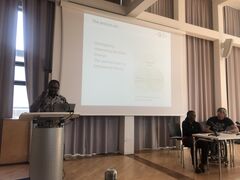

The “Power in Practice” conference was a joint initiative of the Regional Service, the EKiR*, the Mission Academy in Hamburg and the University of Bonn. The focus was on the question of how power works – in diaconia, education, pastoral care, preaching and mission, and in church life in general – particularly in our diverse, global society.
The Regional Service of the United Evangelical Mission (UEM) supports congregations and church districts in discovering ecumenical diversity and strengthening international connectedness. The seven-member team from Tanzania and Germany is active in all regions of the EKiR.
Dimensions of Power
Around 50 participants from Europe, Africa, Asia and the Americas gathered in Bonn, Germany, in mid-June. They included students, academics, church leaders and activists from churches and civil society. Sabine Hübner, Teamleader Regional Service, emphasised the wide range of Christian traditions represented: “The denominational spectrum ranged from Lutheran, Presbyterian and Baptist to Reformed, Pietist, Pentecostal and Evangelical, through to Roman Catholic, Eastern and Indian Orthodox.” The 14 speakers not only spoke from different social perspectives, but also brought with them experiences from many different countries. Rev Godwin Ampony, Head of International Diaconia at the UEM, pointed out in his lecture how various dimensions of diaconal power intersect: pragmatic strength, pastoral care and prophetic vulnerability. Bringing all three dimensions into one’s ministry, Ampony argued, gives the church a very special strength for diaconal action.
Over the course of two days, the conference offered space for lectures, small group discussions and in-depth conversations that clearly showed that power manifests itself in many forms: visible and hidden, formal and informal. Some people inherit power, others are granted it, and some claim it deliberately. The question is therefore not whether power is at work, but how. The aim was both to analyse destructive structures and to enable empowerment. Hübner summarised: “The conference has shown how important it is to make power visible in all its facets – especially in a church that is so diverse and globally interconnected. Only in this way can we work together on just and empowering forms of community.”
UEM: Distributing Power in Mission
In UEM, power and its distribution have been of particular importance since its 1996 internationalisation: at the UEM General Assembly, its highest decision-making body, all member churches from Asia, Africa and Germany are represented. The churches from Asia and Africa hold the majority of the votes. Before every General Assembly, women and young adults meet for their own Pre Assemblies in order to discuss their specific concerns and thus offset structural disadvantages. The next General Assembly will take place in September 2025 in Dar Es Salaam, Tanzania.
*EKiR = Evangelische Kirche im Rheinland (Evangelical Church in the Rhineland, Germany)


 spenden@vemission.org
 0202-89004-195