

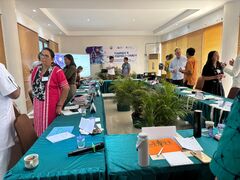

How can the church become a place where children are welcomed, where they feel seen, heard, safe and empowered – not just as the church of tomorrow, but as its living heartbeat today? This guiding question shaped an international workshop held in November in Kuala Kurun (Central Kalimantan, Indonesia).
Eighteen participants from Sri Lanka, South Africa, the Democratic Republic of Congo, Germany, Tanzania, Cameroon, West Papua and Indonesia were invited to share their experiences and ideas. Around 150 people joined the opening celebration, including local politicians, pastors and members of the congregations.
Organized by the United Evangelical Mission (UEM) and hosted by the Kalimantan Evangelical Church (GKE), the workshop “Towards a Child Friendly Church” brought together pastors, practitioners from children’s and youth ministries, educators and theologians. Their conversations reflected both the realities in their local contexts and the shared commitment to strengthen the church as a space where children are supported and protected.
Global Challenges – A Shared Call for the Church
Despite different contexts, participants highlighted that churches worldwide face similar challenges affecting children and families. These include poverty, unequal educational opportunities, sexual violence and abuse, the generational gap in the use of technology and social media, and cultural or societal dynamics that limit children’s participation.
At the same time, many families are under great pressure and face demanding everyday situations. The church, therefore, is called to listen carefully, understand the real experiences of children and families, and accompany them with compassion and courage.
Children as Active Participants in the Life of the Church
Discussions emphasized that children are often treated as objects of ministry rather than active participants. The workshop underlined the need for churches to rethink their ministry with children, ensuring that they are meaningfully included in church life, invited to participate, and accompanied at important milestones. Strengthening parents and families—as the first space where faith is shared, prayers are spoken and Christian festivals are celebrated—was identified as essential for building a child-friendly church.
Key Steps Towards a Child-Friendly Church
Based on the shared reflections, the delegates formulated recommendations for strengthening churches in their commitment to children. These include:
- Establishing clear safeguarding and child-protection policies in every church.
- Cooperating with government institutions and civil society to protect children’s rights.
- Training all staff and volunteers who work with children.
- Establishing structures that enable children’s participation in decision-making.
- Supporting parents and strengthening families as places of faith formation.
- Launching a UEM campaign to promote child-rights awareness and advocacy.
A Common Journey of Commitment
The participants affirmed that a child-friendly church requires a whole-church commitment. Children and adults must be treated as equal members of the church so that children can actively engage, contribute and grow within the community. A safer, stronger and more hopeful church for children is possible when hearts, minds and hands work together.
Download the workshop recommendations here
For further information: Sabine Hübner and Yoram Karusya, Regional Service of UEM



 spenden@vemission.org
 0202-89004-195