

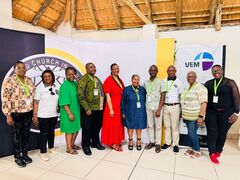
"Leadership Capacity Building - Church Sustainability", this was the topic of a joint workshop for URCSA* leaders, a member church of UEM, and the Africa Regional Office of the United Evangelical Mission in South Africa. Eight URCSA synod regions—Cape, Free State, Lesotho, Southern, Northern, KwaZulu-Natal, Phororo, and Namibia—sent representatives covering five different church ministries, including women's and youth work.
The meeting was officially opened by the Moderator of URCSA, Rev. Prof. Leepo Modise. He reminded the participates of the importance of good planning. In the Bible, this is illustrated by Joseph’s interpretation of Pharaoh’s dream: “God has shown Pharaoh what He is about to do. Indeed seven years of great plenty will come throughout all the land of Egypt. But after them seven years of famine will arise. And all the plenty will be forgotten in the land of Egypt. And the famine will deplete the land.” The Egyptian government’s response in terms of preparation depicts: sustainability requires planning and human resources.
Becoming a sustainable church
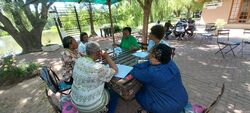
In small groups and joint discussions, strategies were developed to generate local income that enables sustainable management while also creating resources to support United Action.
Ideas that were discussed include
- Renting out Church Property: This is one of the the most common income sources. Various assets of the church can be rented out: buildings, land and vehicles.
- Creating Self-Sustaining Ministries: A self-sustaining ministry is a program that brings in enough income to meet its own expenses.
- Starting a Social Enterprise: A social enterprise is about two things at the same time - social impact and financial return. Starting and maintaining a social enterprise requires professionals and experts in the congregation. They can support the business and form a nonprofit organization.
- Realigning the Congregation’s Budget: If budgets are pruned, one will reallocate budget finances. This is often the best first step to gain broader mission alignment and make effective use of finances.
- Shifting Church Leadership Model: Many congregations find financial freedom in changing their staffing model. They go from clergy-led, lay-supported to lay-led, clergy-supported. This does not mean that paid ministry leaders are sent away entirely, but they play a different role. Ministry leaders still offer their specific gifts to the congregation, but most of the ministry is led by people in the pews.
Reuben Inganji, Project Officer for the Africa Region emphazid that quality programming is the cornerstone of resource mobilisation in the church and any organization. Good relations with resource partners, accountability and transparency which can be built throughout the design stages of church activities to guarantee sustainability of Gods mission. And Rev. Dr. Earnest Kadiva, Head of Africa Region, reminded the URCSA leadership that sustainability involves not using up the world's natural resources and ensuring that the planet is cared for and preserved. As stewards of God's creation, Christianity teaches that humans have a responsibility towards the environment.
*URCSA = Uniting Reformed Church in Southern Africa



 spenden@vemission.org
 0202-89004-195