

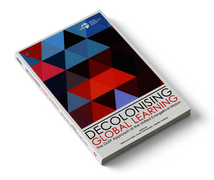
The United Evangelical Mission has published its new publication "Decolonising Global Learning – The GLEP Approach of the United Evangelical Mission." Across 171 pages, the book presents the concept of "Global Learning in Ecumenical Perspective" (GLEP): an internationalised, diverse learning model that seeks to overcome colonial and paternalistic patterns of thought – patterns that continue to shape churches and Christian institutions today.
16 authors from the international ecumenical community contributed articles, lectures, and research papers on the topic, including former UEM Moderator Willem Simarmata, who passed away in 2022, and Prof. Claudia Jahnel from the Department of Protestant Theology at the University of Hamburg.
The editors – Rev. Marie-Anne Halim (Head of the Germany Region of UEM), Rev. Andar Parlindungan (General Secretary of UEM), and Angelika Veddeler (retired, co-developer of the GLEP model) – hope the book will spark further academic development: "We expect that this publication can be studied together to develop this concept further academically. It is part of the nature of GLEP that this learning model remains open to being challenged and rethought by the many people interested in global learning."
UEM Expertise Against Colonial Thought Patterns
Decolonising learning has long been a central concern for UEM. The editors see the current social polarisation – in Germany and worldwide – as a signal that new forms of living together are needed, both globally and locally. The international communion of churches brings its own experience to this task, drawn from a long history of living and learning together across borders.
The book's back-cover blurb names the problem directly: the labelling of "recipients" and "donors" continues to shape relationships between churches of the Global South and North – as does the assumption that churches of the North have something to teach churches of the South. The authors want to leave such paternalistic attitudes behind and grow together instead.
11 Steps for Learning Together
The GLEP concept describes eleven steps for learning together:
Create a diverse environment with varied groups
Identify topics together
Compose diverse leadership teams
Set goals together with the groups carrying the programme
Communicate about the boundaries of accepted values
Plan content and structures together
Learn together in diverse, international groups
Teach together – with trainers from different regions and professional fields
Manage together, transforming traditional educational roles
Find methods and places that encourage many perspectives
Perceive and transform conflicts
The aim is to learn together – not from one another, about one another, or alongside one another – in order to overcome outdated dichotomies of “us here” and “them there”.
The book is available for free download on the UEM website here.



 spenden@vemission.org
 0202-89004-195