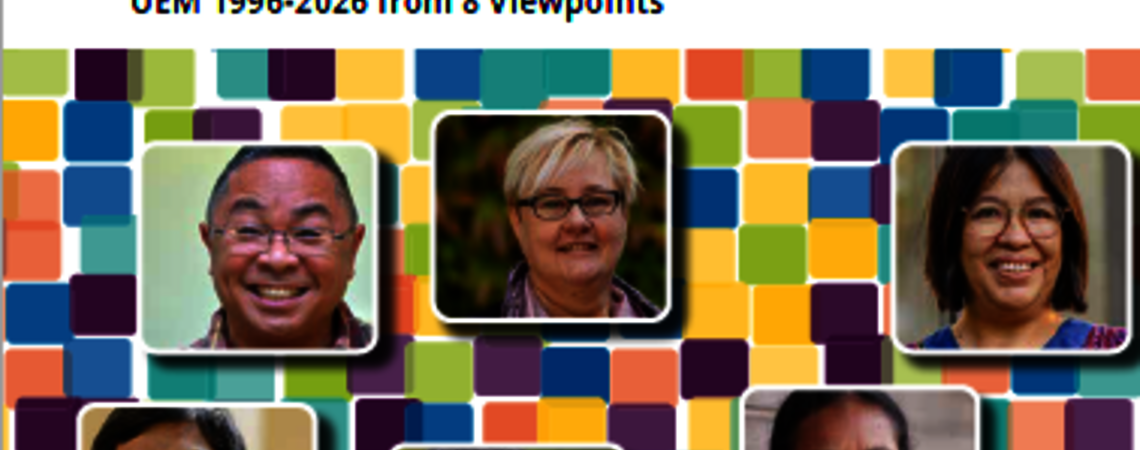
In 2026, the UEM will celebrate the 30th anniversary of its internationalization. Since 1996, all UEM members have been involved in the organization’s leadership and are part of decision-making processes—a fundamental change from the time before, when decisions were made exclusively by Germans. Since then, members from Africa, Asia, and Germany have been jointly represented in decision-making bodies at the regional and international levels. Read more
What kind of church do we want to be in the future? A church that looks inward and preserves its traditions and structures? Or a church that thrives on relationships—across cultures, continents, and experiences? We cordially invite you to read the following articles, reflect on them, and let them speak to you. May they encourage you to understand internationalization not merely as a structure, but as a calling—and to actively participate in the life of this global community. Read more

Crucial to my vision of a new form of shared mission were the 17 years we spent in South Africa from 1953 to 1970 and our first mission station, Mmasealama (Kratzenstein), which we moved into after nearly two years of getting to know the country.

The UEM in Wuppertal was led by a mission leadership, an independent directorate that is not very different from the former leadership of the mission society.

We do not attack mission stations. And when you look at the missionaries’ graves, you can see how we continue to respect them to this day, because we are grateful.

In the summer of 2026, the five-member Executive Board will consist of: Andar Parlindungen (Secretary General), Diyah Krismawati (Deputy Secretary General), Emmanuel Muhozi, Félcité Ngnintedem, and Baraka Lwakatare (Deputy Executive Director).

Four council members each represent the VEM regions of Africa, Asia, and Germany. In addition, there is a youth representative from Indonesia, a financial advisor from Africa, and a legal advisor from Germany.

Our General Assembly is our highest decision-making body. It consists primarily of delegates from our Asian and African members. The German delegates are in the minority. Our 2025 General Assembly was held in Dar es Salaam, Tanzania, at the invitation of the ELCT-ECD.

Currently, a significant portion of the UEM budget is funded by churches in Germany. At the same time, churches in Africa and Asia have become increasingly aware of the need to take on more responsibility for financing the joint budget.
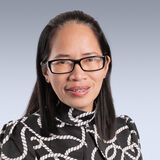
Since UEM’s internationalization in 1996, UEM Sundays in Asia have been an integral part of its journey. Over the past three decades, they have played a key role in shaping UEM’s identity and strengthening its global, cross-border mission across cultural and denominational boundaries.
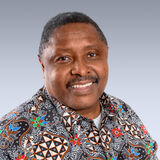
Financial flexibility is often limited by challenging economic conditions. However, since the internationalization of UEM, targeted strategies have been developed to strengthen the economic resilience of member churches.

After almost three decades in leadership within the UEM, as an elected Vice Moderator several times and long-serving chair of the International Finance Committee, I do not answer the question of resources first of all with: money. Anyone who thinks only of money in the UEM does not go far enough.

The Lutindi Mental Hospital in the Northeast Diocese of the Evangelical Lutheran Church in Tanzania was founded in 1896 as a refuge for freed slave children. After the end of the slave trade, it was converted into the first psychiatric hospital in the former German colony of “German East Africa.”

The theme “Only those who share can make decisions together” expresses a central conviction of contemporary missiology: Participation in the missio Dei requires shared judgment, shared responsibility, and shared accountability.

If a sense of “togetherness” is to emerge, it is essential from an intercultural perspective that the “liminal space” between cultures be entered—that is, that both sides be willing to step outside their own cultural space. The “liminal space” between cultures is vulnerable.

„Dear Sisters and Brothers,“
Every Prayer Alert begins with this salutation. Perhaps this is not surprising for a call to prayer within a Christian community. And yet, so much is already contained within it: relationship, familiarity, and a spiritual, brotherly bond that transcends languages, countries, and continents.

These emergencies and others call for reflection on a persistent dilemma: how do we, as a Mission Organization, respond courageously and compassionately to human suffering without reinforcing stereotypes of dependency, helplessness, or unilateral aid—particularly between churches and communities in the Global North and South.

As a young college graduate full of enthusiasm, I traveled to Germany to work as a volunteer. The first few months were very challenging. Coming from the Southern Hemisphere, I experienced culture shock: a different language, a different climate, different food, and a different way of life—all of which required me to adapt.

West Papua remains largely underrepresented in international political debates. While geopolitical interests, the exploitation of economic resources, and security considerations dominate the political agenda, the perspectives of the people in the region receive little attention.

For me, anti-racism work is not just an “add-on” program separate from our history. It is a concrete way to take our international identity seriously. In this way, we learn to live out what our constitution already states: that, as the body of Christ, we belong together across regions, histories, and unequal privileges.
And from the very beginning, the question of power has also been raised within this movement. Can people be partners when one comes from the wealthy Global North and the other from the impoverished Global South? What can our shared future look like when the question of power is not always resolved?

There is a fundamental belief that pastors and social workers share, and without this fundamental belief, these two professions would make no sense—or, worse still, they would not even exist! This fundamental belief is: People are capable to change themselves!

All of us—the people in the member churches, church leaders, members of UEM governing bodies, partnership groups, and we, the staff—had to overcome or “unlearn” old patterns and learn new ones, both in major and seemingly minor matters.

For a long time, UEM was of the opinion that the administration—and especially the management—had to be German. To be honest, an international financial administration and international staff in administrative positions seemed almost unthinkable.

The relationship between power and mission during the colonial era is complex and fraught with tension. Power and mission were often seen as two sides of the same coin: colonial rule made use of missionary activities to legitimize political, economic, and cultural expansion.

If United Evangelical Mission (UEM) did not exist, we would have to invent it: As a church community spanning three continents, the UEM serves as a vital gateway for the Evangelical Church in the Rhineland (EKiR) to the international sphere and the issues associated with it.
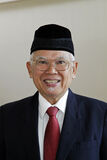
Do you have a message for UEM?
Yes, please interpret history correctly and take the necessary steps to help all churches remain more faithful to their calling in this new era of the Fourth Industrial Revolution.

For many, UEM is simply an organization from which they receive funding and through which they carry out projects—that’s all. They see no difference between UEM and other donor organizations with which they collaborate. That is why UEM’s institutional memory must be rewritten so that future leaders in Africa, Asia, and Germany can carry on its mission.

This booklet is a witness of faith, love and hope. People in the UEM community share their experience with a unique church body. I found so many of my own experiences with UEM in their words. Read more


IBAN: DE45 3506 0190 0009 0909 08
SWIFT/BIC: GENODED1DKD
 spenden@vemission.org
 0202-89004-195
info@vemission.org
0202-89004-0
presse@vemission.org
0202-89004-135
CRDB BANK PLC / Branch 3319
Account# 0250299692300
Swift code: CORUTZTZ
Bank BNI
Account# 0128002447
Swift code: BNINIDJAMDN
info@vemission.org
presse@vemission.org